
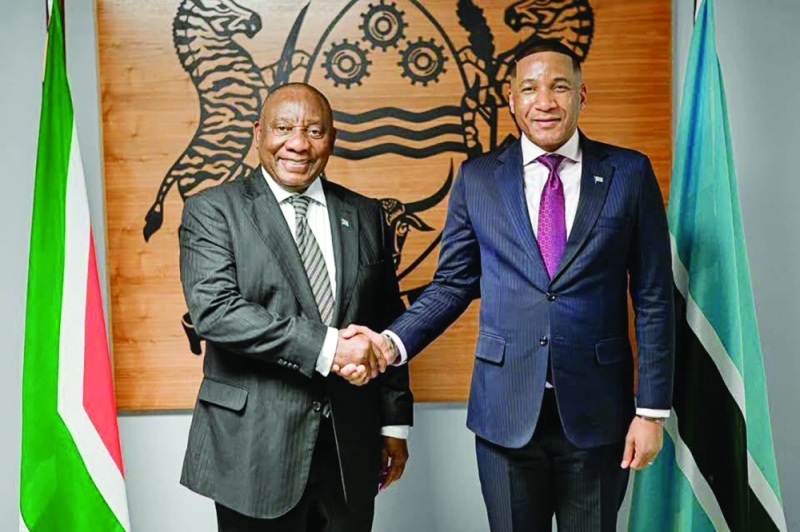

Gathering in Gaborone ahead of the ministerial and Heads of State engagements, senior officials from both countries signalled a deliberate shift from diplomatic declarations to actual delivery.Botswana’s Permanent Secretary in the Ministry of International Relations, Ambassador Thuso Ramodimoosi, framed the moment not as another routine bilateral engagement, but as an opportunity to demonstrate that diplomacy can produce visible results.“We collectively agreed to accelerate progress on all outstanding issues across the key pillars of our cooperation, namely, political and diplomatic relations, economic cooperation, defence and security, as well as social and cultural exchanges. It is pleasing to note that numerous exchanges continue to take place between our respective Ministries and Departments. These continued interactions stand as a testament to the enduring strength and depth of the bilateral relations between our two countries,” Ramodimoosi said.While welcoming progress made since previous engagements, including Mid-Term Reviews held in November 2023 and July 2025, Ramodimoosi announced that seven legal instruments of cooperation have now been finalised and are being cleared for signing during the BNC Session. “These instruments represent tangible progress in our bilateral relations and serve to further deepen cooperation,” he said.
But he cautioned against measuring success only by signatures and ceremonial milestones.“Success must be reflected not only in the number of signed instruments, but also in the positive impact these agreements have on the lives of the citizens of our countries,” Ramodimoosi pointed out. He called for improved coordination, regular monitoring, and transparent reporting mechanisms and urged technical teams to establish clear implementation timelines and follow-up processes.Ramodimoosi also challenged delegates to ensure that discussions result in clear, tangible and actionable outcomes that can be elevated to Ministers and ultimately to the two Heads of State. South Africa’s Deputy Director-General for International Relations and Cooperation, Ambassador Tebogo Seokolo, echoed the emphasis on delivery but widened the lens to place Botswana–South Africa relations within a rapidly changing global order.The South African delegation also congratulated Botswana for hosting the 8th edition of the World Athletics Relays, describing it as a historic achievement for Africa. “We meet at a time of profound developments in the world. The international geopolitical arena has become fluid, unpredictable, contested and even contains elements of fragility.
We need to redouble our collective efforts to achieve a peaceful and secure world, including a stable Africa,” Seokolo added. He warned that multilateralism itself faces strain and called for stronger African coordination. Seokolo argued that Botswana and South Africa must deepen practical cooperation.“It is thus incumbent on South Africa and Botswana, as strategic neighbours and allies, to cooperate more closely in the spirit of solidarity,” he pointed out. Seokolo reminded delegates that relations between the two countries were forged during the anti-colonial and anti-apartheid struggles. “This solidarity remains firmly etched in our collective memory, and Botswana continues to hold a special place in the hearts of South Africans.” Beyond diplomacy, South Africa outlined what could become the next generation of bilateral game changers.
For example, Seokolo called for identifying four to six high-impact priority areas, pointing specifically to infrastructure and regional integration.Among the flagship projects identified were the Mmamabula–Lephalale Rail Link, the project development of the Groblersbrug/Martin’s Drift border post, and the establishment of a One Stop Border Post (OSBP) at Tlokweng/Kopfontein. He also highlighted expanded cooperation in agriculture, mining, water, science and technology, and defence.South Africa further signalled support for Botswana’s development agenda under the Twelfth National Development Plan (NDP 12), particularly its emphasis on private-sector-led growth, industrial diversification and export competitiveness.“Botswana can count on us,” Seokolo said. On water security, he pointed to the proposed Lesotho–Botswana Water Transfer Project (LBWTP) as a strategic regional initiative with the potential to strengthen long-term development and integration. South Africa's representative said the two countries have concluded 39 legal instruments, including 28 bilateral agreements covering multiple sectors.
As South Africa prepares to chair SADC engagements leading to the 46th Ordinary Summit of SADC Heads of State and Government in Durban in August 2026, Seokolo called for stronger regional alignment and accelerated implementation of cross-border projects and regional value chains.