
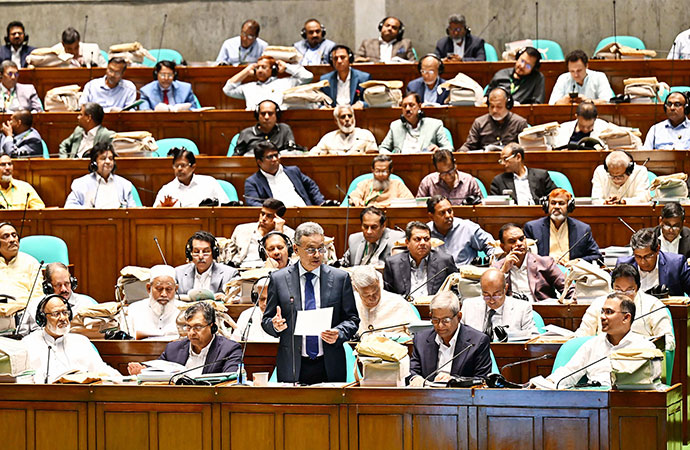

Finance Minister Amir Khosru Mahmud Chowdhury on Thursday placed the budget for the 2026-27 fiscal with a call for national unity, inclusive development, and continued reform-driven progress, emphasising the collective role of citizens from all walks of life in building a prosperous Bangladesh. This is the first budget of the BNP government after winning the February 2026 election. Amir Khosru Mahmud Chowdhury as the finance minister delivered his maiden budget speech under the theme 'Journey Towards a Democratic, Humane and Inclusive Economy'. In the course of his nearly 4-hour budget speech, Amir Khosru, dressed in a dark grey suit paired with dark blue tie, repeatedly urged lawmakers and citizens including farmers, workers, students, women, youth, and expatriates to strengthen cooperation in achieving the country's development aspirations.
The finance minister took just two short breaks - that too for the Asr and Maghrib prayers. He disclosed the government's vision to reduce inflation to 7.5 percent and raise GDP growth to 6.5 percent in the coming fiscal (2026-27). For this, Khosru said he wants to rely on inclusive development, quality education and healthcare for all, universal social protection, an economy driven by investment, employment, and production. He said he wants to step up deregulation and present a cost-effective, simplified business environment, financial sector stability, energy security, digital transformation and ICT development, management of life, nature, environment, and water resources and transparent, efficient, and accountable institutions and administrative systems.
The address highlighted that Bangladesh's progress depends on the sustained implementation of electoral commitments, bold reform initiatives, and a united national effort. "We firmly believe that through continued implementation of our electoral commitments, bold reform initiatives, and a united national effort, Bangladesh will advance steadily toward its development aspirations," the Finance Minister said. He said that it underscored the vision of building a society where equal opportunities are accessible to all, enterprise and innovation are encouraged, and the rewards of hard work are ensured, with the benefits of economic growth shared broadly among citizens. "Our commitment is to build a Bangladesh where equal opportunities are available to all... through economic democratisation, deregulation, and the empowerment of the people, we shall build a prosperous and confident Bangladesh, InshaAllah," he added.
Highlighting the importance of human capital, he said the strength, creativity, and entrepreneurial spirit of people remain the nation's greatest asset. The proposed national budget for the 2026-27 fiscal, which is set to be the largest on record, has been framed with a strong emphasis on economic stability, investment, production, employment generation and building a more equitable society.
The government has set out an ambitious long-term vision of transforming the economy into a USD 1 trillion economy by 2034 through sustained and stable economic growth, driven by what it describes as "economic democratisation", aimed at ensuring financial recovery and welfare for all citizens. The budget claims to prioritise a shift away from debt-dependent growth towards a production- and private investment-led economic model. In the medium term, efforts will be made to increase revenue collection, maintain budget deficits at sustainable levels, and restore discipline in debt management, with the aim of improving the country's credit rating from moderate to low risk. The budget deficit has been targeted at 3.6 percent of GDP, which will help keep borrowing risks at a manageable level, if maintained.
To encourage private sector investment, government borrowing from the banking sector will be gradually reduced. Or that is the plan at least.
The government plans to diversify and strengthen the bond market through the introduction and expansion of corporate bonds and municipal bonds, thereby easing pressure on the banking system. For the 2026-27 fiscal year, total revenue collection has been projected at Tk 6,95,000 crore, equivalent to 10.2 percent of GDP. This is quite possibly the most ambitious aspect of what is decidedly an ambitious budget, given that the tax-to-GDP ratio fell below 7 percent in 2024-25. A whopping Tk 6,04,000 crore is expected to come from the National Board of Revenue (NBR), i.e. tax collection, and the government has said efforts will be made to significantly increase it in the coming years.
Although how to do this while ringfencing corporate tax rates and not targeting the highest income earners in society is anybody's guess. According to data from the Centre for Policy Dialogue (CPD), the NBR suffered a staggering shortfall of Tk 1.04 lakh crore during the July-April period of the outgoing fiscal year FY 2025-26, and that was with a much lower target than what is being proposed as the target for the next budget. The total outlay proposed, or budget size, clocks in at a hefty Tk 9,38,000 crore, comfortably the largest ever in the country's history, covering both operational and development spending. It signals a return to the expansionary fiscal policy that characterised much of the deposed Awami League government's tenure from 2009-24.
The interim government led by Dr Muhammad Yunus bucked that trend, as Finance Adviser Dr. Salehuddin Ahmed unveiled a Tk 7,90,000 crore national budget for the 2025-26 fiscal, marking a rare contraction of about 1% from the previous year's outlay. If Khosru's proposed budget is passed without any major changes, it would mark an 18% jump over the current year's budget. One of the most significant points of departure between the two is the return to a much larger Annual Development Programme.
Operational expenditure includes subsidies, interest payments on public debt, procurement of capital equipment, food accounts, and administrative costs including advances to employees and state-owned enterprises. The development budget, which is mainly made up of the ADP but includes some non-ADP schemes as well, stands at Tk 3,16,075 crore - nearly a third of the total outlay, even as the government insists it is going to prioritise investment-led growth and sustainable development initiatives. In line with the BNP's promises on the campaign trail, the allocations for education and health have been significantly ramped up with a view to improve human capital development. The education sector has been allocated around 2 percent of GDP, amounting to Tk 1,36,606 crore, compared to Tk 87,206 crore in the current, outgoing fiscal.
The allocation spans multiple ministries beyond education including technical and vocational institutions under different sectors such as textiles, railways, defence, agriculture, fisheries, and ICT. Similarly, the health sector's allocation has been increased to Tk 69,409 crore, equivalent to over 1 percent of GDP, up from 0.58 percent in the current, outgoing fiscal. The allocation includes spending by various ministries and agencies, including local government bodies, the Islamic Foundation, police-run hospitals, and social welfare institutions.
The government has indicated a plan to gradually raise combined education and health spending to 5 percent of GDP in the future. Still firefighting The new government cannot afford to just look ahead, it must constantly deal with some of the lingering effects of the authoritarian era under Awami League. In a demonstration of this, the government has earmarked a huge fund of Tk 40,000 crore in the proposed national budget to bail out and stabilise the struggling banking sector. The massive financial package comes as a desperate measure to salvage several weak and distressed commercial banks and Non-Bank financial Institutions (NBFIs) currently grappling with severe liquidity crunches, rising non-performing loans (NPLs), and eroded capital adequacy.
According to Ministry of Finance sources, the allocation will be utilised to inject fresh capital, stabilize liquidity frameworks, and restore public confidence in the financial system. Economists and sector experts view this as one of the largest state-backed banking rescue operations in the country's history.
The announcement of this package arrives at a critical juncture for Bangladesh's economy. Recent central bank evaluations have flagged multiple commercial banks-particularly state-owned entities and several private sector Islamic banks-as highly "vulnerable." The government's traditional safety net-borrowing from local commercial banks-is running thin due to deep banking sector fragility. "Decades of poor governance, political cronyism, and unmitigated loan rescheduling have pushed the non-performing loan (NPL) ratio to a historic 30.6 percent," said Dr. Zahid Hussain, a former Chief Economist at the World Bank's Dhaka office.
With billions of taka trapped in default loans, local banks are facing severe liquidity crunches. Economists warn that the government's excessive domestic borrowing-which reached 98.5 percent of its full-year target by March 2026-risks completely "crowding out" private sector credit, starving legitimate businesses of capital, he pointed out. Sharing his immediate reaction to the proposed budget, Dr Ahsan H. Mansur, who was unceremoniously removed from his position as the governor of Bangladesh Bank within days of the BNP assuming power, emphasised that concrete structural reforms, rather than mere promises, are essential to restore stability to the financial sector.
He also touched upon efforts to dismantle single-family or concentrated control over commercial banks. "We previously proposed amendments to the Bank Company Act to limit the tendency of families to maintain excessive control over commercial banks. If these amendments are implemented, we will know that the government is genuinely sincere about reducing single or concentrated ownership. We want to see these reforms materialise," Dr.
Mansur said. Highlighting the critical issue of external interference in the banking sector, the noted economist stressed that the independence of the central bank, as the regulator, must be safeguarded through legislative backing. He disclosed that a draft proposal aimed at bolstering the autonomy of Bangladesh Bank had been submitted to the government and remains under consideration. He credited the current Adviser on Economic Affairs, Dr.
Rashed Al Mahmud Titumir, with contributing significantly to refining the draft during his tenure on the Bangladesh Bank board. "If this revised draft is approved, Bangladesh Bank will become truly independent, and only then can we effectively eliminate external interference. Interference will not stop on its own," he noted. Dr.
Mansur also raised questions regarding the status of the Financial Institutions Division (FID) within the Finance Ministry, pointing out a mismatch between government pledges and the ground reality. "The government had previously talked about abolishing the FID, and the Finance Minister himself expressed this intention.
However, the division continues to function with full authority. If the government is truly committed to reducing state intervention, it should move forward with this crucial institutional reform," he stated. Warning that the ongoing economic uncertainties are largely self-inflicted, the former governor stressed that only visible, decisive actions can rebuild public trust and bring order back to the financial landscape. Khosru's post-budget briefing In his first remarks after placing the proposed budget for the next fiscal in Parliament, Amir Khosru Mahmud Chowdhury said the government expects inflationary pressures to ease gradually through structural reforms aimed at reducing the cost of doing business, improving efficiency and strengthening supply chains.
"Inflation in Bangladesh is not a short-term phenomenon but the result of several years of accumulated pressures, compounded by global conflicts, rising import costs and weaknesses in the banking sector," he said on Friday, while addressing a post-budget press conference at the Osmani Memorial Auditorium. The finance minister, who presented his first budget on Thursday, noted that inflation has remained above 9 percent for the past three years. External factors, including conflicts in the Middle East, have pushed up global commodity prices, while capital shortages in banks caused by loan defaults, fraud and money laundering have increased the cost of funds. He said that imported goods had become more expensive due to global developments and that Bangladesh had limited control over such external inflationary pressures.
However, the government could reduce domestic inflation by lowering business costs through deregulation, administrative reforms and improved efficiency, he said. According to Amir Khosru, businesses in Bangladesh face excessive costs due to lengthy approval processes, bureaucratic delays, high borrowing costs, inefficiencies at ports and weaknesses in taxation and regulatory systems. "Inflation cannot be controlled by deploying police, regulatory agencies or government officials in markets. It has to be managed through sound policies and efficient administration," he said.
The newly elected BNP government's first budget set an inflation target of 7.5% for the next fiscal, against a GDP growth expectation of 6.5%. Khosru said the government would focus on improving ease of doing business, reducing unnecessary regulations and ensuring greater transparency across public institutions. He added that reforms in ports, logistics and procurement systems would also help lower costs. The finance minister stressed the need for long-term procurement planning, saying Bangladesh should maintain strategic reserves of fuel, food and fertiliser to reduce vulnerability to global market shocks.
Referring to energy imports, he criticised past reliance on spot purchases and said the government intended to pursue longer-term procurement arrangements to secure better prices and ensure energy security. On the government's decision to increase salaries for public servants, Khosru said the move was necessary to address rising living costs after years without significant adjustments. "When people face financial hardship, the tendency towards corruption increases. Improved salaries should help reduce that pressure while ensuring a better standard of living for government employees," he said.
The finance minister also highlighted employment generation as a central objective of the budget, saying investments in education, skills development and private-sector growth would help create jobs both at home and abroad. He said the government had placed particular emphasis on vocational education, reskilling and upskilling programmes to improve employability, especially among young people and educated jobseekers. "Investment means employment. Our focus is on creating demand for jobs through increased investment and improved skills," he said.
Khosru said the budget represented a shift from traditional approaches and reflected changing global economic realities. He reiterated the government's commitment to reducing dependence on domestic bank borrowing, which he said often crowded out private-sector lending. He noted that planned borrowing from local banks had already been reduced compared with the previous fiscal year and that the government would continue this trend in the coming years.
The minister also defended the budget's emphasis on social protection programmes, saying the largest investments were being made in initiatives designed to support low-income and vulnerable groups. Programmes such as the Family Card, support for farmers, universal healthcare and preventive healthcare services were aimed at improving living standards while preparing beneficiaries for better employment opportunities, he said. Khosru placed special emphasis on the government's proposed "creative economy" initiative, which seeks to integrate artisans, cultural workers, performers and rural entrepreneurs into the mainstream economy. He said the programme would provide financing, training, design support and market access to traditional craftsmen, weavers, potters, musicians and other creative workers whose contributions had long remained outside formal economic planning.
The minister said the government had allocated Tk 800 crore to launch creative economy initiatives, including creative centres, cultural districts, tourism-linked projects and heritage restoration programmes. "Our objective is to monetise culture and creativity so that artists, craftsmen and performers can improve their livelihoods while contributing to economic growth," he said. Khosru also said the government was reviewing outdated mouza land valuation rates, which are often significantly below market prices, to curb opportunities for whitening undisclosed income through property transactions. A committee has been formed to revise mouza rates and bring them closer to actual market values, although he acknowledged that the exercise would require a nationwide survey and could not be completed before the budget.
Responding to concerns about implementation, the finance minister said the government would establish a high-powered task force and an online complaint platform to monitor reform measures and ensure accountability. "No one will be exempt from scrutiny if delays or violations occur. We are committed to implementation," he said.
Earlier, in his opening remarks, Khosru described the budget as an "inclusive" one prepared under exceptional circumstances within less than two months of the new government's formation. He said the budget sought to move away from what he described as a patronage-based economic model and instead promote "economic democratisation" by extending opportunities to all sections of society.
The minister said the government inherited an economy weakened by institutional erosion, financial mismanagement and global economic uncertainty, making budget preparation particularly challenging. He added that future public spending and development projects would be evaluated on four key criteria: value for money, return on investment, job creation and environmental sustainability. "The budget is for all Bangladeshis. No group, profession or community has been left outside its scope," he said.
Additional reporting by UNB.