
Sports
Under the radar here, Singapore aeromodelling teams take historic third place at world meet
straitstimes.com
•28 May 2026, 10:00 AM
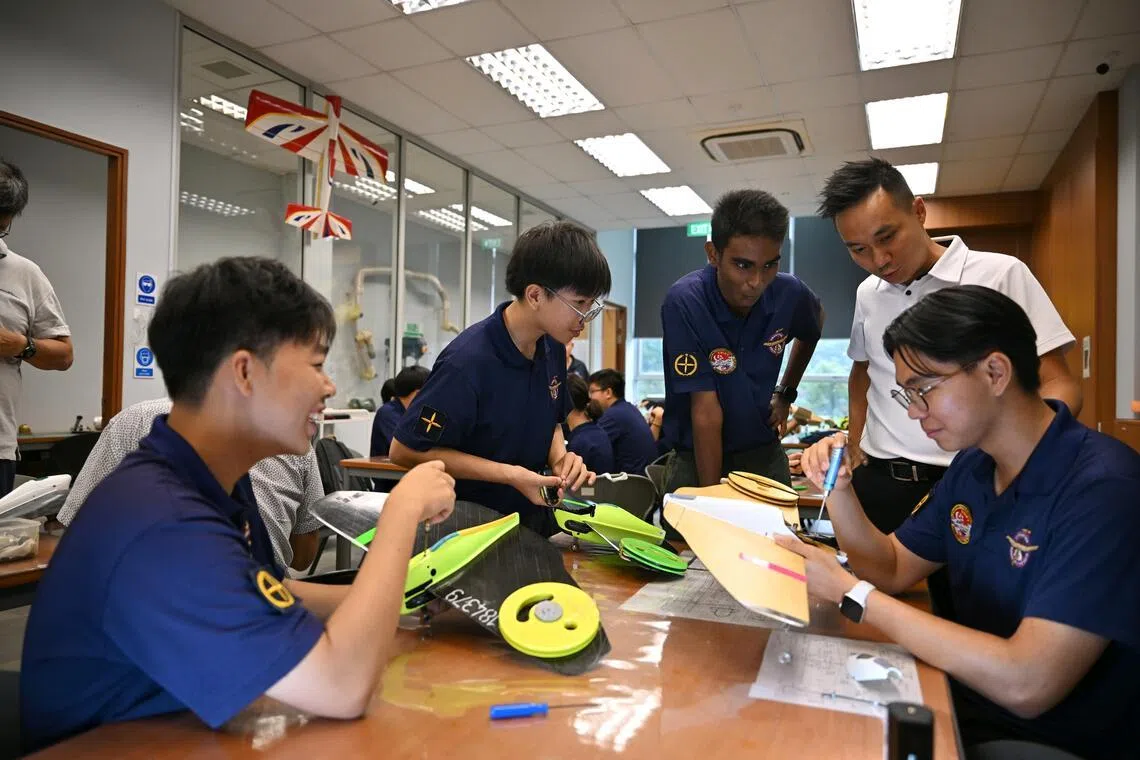

SINGAPORE – At an open space near Seletar Airport on a Saturday morning, two teens stand with their backs against each other. Fingers wrapped around a handle, they begin to manoeuvre a model aircraft about 1m wide by pulling wires about 16m long tethered to the miniature plane. Like flying a kite – only far faster – the two students, Daryl Chow, 19, and Melvin Tan, 18, remain in a tight circle of less than 3m in diameter as they pilot their model aircraft for about three minutes, racing through 100 laps at speeds of about 230kmh. Nearby, their mechanics, Moovendra Vickineswaran, 15, and Ethan Lok, 14, kneel with eyes fixed on the model aircraft, ready to grab it by its wing, refuel it within seconds and get it airborne again with a quick flick of the propeller.
The four are members of the control line special interest group in the Singapore Youth Flying Club (SYFC) CCA, which is offered in 17 secondary schools. They were also among Singapore’s representatives at the 2026 F2 FAI World Championships for Control Line Model Aircraft held from May 2-8 in Perth, Australia. FAI is short for Federation Aeronautique Internationale, or World Air Sports Federation. Historic podium placing There, Singapore finished third in the F2C team-racing country classification – the Republic’s best performance since it began competing in 2000, sharing the podium with powerhouses Poland and Australia.
Aside from the quartet of teens, Singapore was also represented in the category by Mr Kevin Su, 35, with his mechanic Christopher Wee, 68. Fellow Singaporeans, pilot Lee Ming Xuan, 23, and mechanic Richard Ong, 61, made up the Republic’s contingent in the F2C.
Speaking to The Straits Times after returning to Singapore, Mr Su, who is the CCA manager for SYFC and developed his interest in control line since he was 12 when he became a member himself, described the uphill task Singapore faced in securing the result. Singapore fielded among the youngest teams at the championships, Mr Su said. “They have done exceptionally well going up against other countries,” Mr Su said, referring to his four students. “Aeromodelling is a very old sport. They were going up against people with twenty or thirty years of experience more,” he added. Aeromodelling involves the designing, building and flying of model planes, and includes activities like control line flying, remote-controlled flying and quadcopter flying.
The amount of effort and time the students forked out is commendable, Mr Su said, adding that “the result speaks for itself”. The students, who were selected after rounds of internal competitions, all sacrificed school time to prepare for the contest. Melvin, who sits the A Level examinations in 2026, said he took time off from classes over a period of almost two months before the competition to work himself up to a more competitive level. He said it was not easy getting his parents, teachers and principal to allow him to go for extra practice sessions on Wednesdays and Fridays, apart from the regular Saturday ones.
At the award ceremony in Perth, he was overcome by emotions. “I was on the brink of tears,” said Melvin. “When all is said and done, being able to represent Singapore and SYFC was a massive and pivotal moment in my life.” Also competing under Singapore’s flag was Mr Jake Moon, 30, an American citizen who took part in the aerobatics-focused F2B category, where the pilot performs manoeuvres such as loops and figure eights. He was the only person representing Singapore in that category in 2026. Mr Moon, who moved to Singapore in 2023, told ST that under FAI rules, he was able to compete for Singapore since a person can compete under a country they are not a citizen of if they have lived there for at least 185 days. He picked up control line only in recent years, although he has been around F2B “my whole life”.
His father and uncle are both very competitive F2B flyers in the US, the Texan said, adding that they have been doing it “longer than I’ve been alive”. Mr Moon said he started taking F2B flying seriously in 2023, after realising that he could fly in World Championship competitions for Singapore. He placed 36th out of 44 participants in the F2B category. He ranked 38th out of 47 in the previous world championship.
Aeromodelling in Singapore There are about 1,300 students in the SYFC CCA, Mr Su said, describing SYFC as a key contributor in control line and the aeromodelling scene. He estimated that the local community numbers between 5,000 and 10,000 enthusiasts. The niche sport – still largely under the radar of the general public – has long had its fair share of challenges, chief among them is the lack of flying space, Mr Su said. As the Civil Aviation Authority Singapore tightened regulations, members of the public can no longer fly within 5km of an aerodrome – any defined area on land or water intended to be used for the arrival, departure and movement of aircraft – which has significantly limited available flying zones, Mr Su said. “Fortunately, at SYFC, we are equipped with a dedicated flying circle for control line and a hangar for radio-controlled activities, providing a safe and structured environment for our CCA members,” he said.
For enthusiasts such as Mr Moon, who flies a larger model aircraft with a wingspan of 160cm and does not have access to such facilities as a non-citizen, training often takes place in parks outside no-fly zones. The next FAI F2 World Championships for Control Line Model Aircraft is expected to be held in 2028, in France. Those interested in learning about aeromodelling activities can visit SYFC’s website at www.syfc.sg