
Football
What football genius Pep Guardiola can teach Britain’s middling politicians
straitstimes.com
•25 May 2026, 10:00 AM

Viewed from Asia, you cannot help but feel deep sympathy for Britain as it muddles through this century, looking increasingly ungovernable. This is the home of Westminster politics, the governance system we former British colonies – Singapore, Malaysia, India and others – inherited and adapted to suit our local conditions.
But by any measure, that lodestar today seems to be teetering on dysfunction. In the last decade, half a dozen prime ministers have tried and failed to impose stability. Prime Minister Keir Starmer, who swept to power two years ago as the sixth of these, is now fighting for his political life, hoping to avoid the swift exit visited on his five Conservative predecessors. This is, at root, a leadership problem: the mainstream parties keep picking the wrong person for the top job, and the rest unravels.
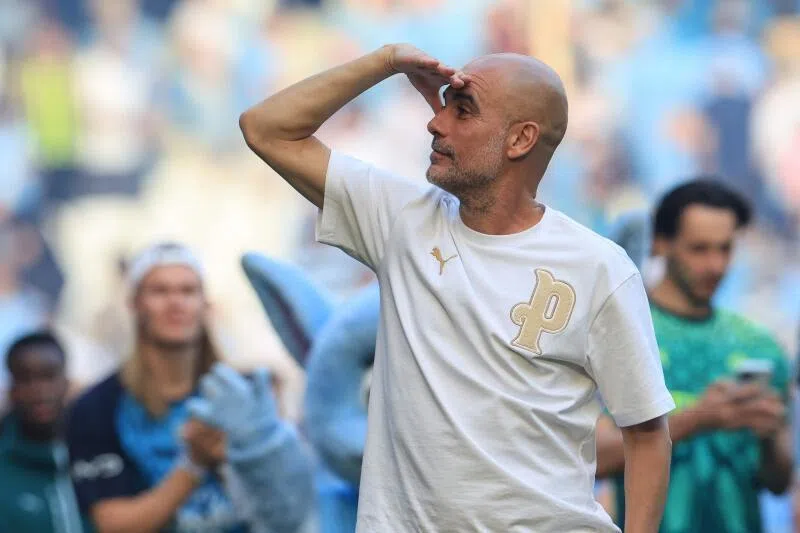
Watching the emotional send-off Manchester City gave manager Josep ‘Pep’ Guardiola on Sunday, as he wrapped up a magisterial decade at the club, an obvious question came to mind. Surely, in this long winter of underwhelming leaders, Britain’s political establishment should take a leaf from English football, which, unlike politics, boasts world-class talent. Where is their equivalent of a bricklayer’s son turned the most relentless serial winner in modern football? At Manchester City alone, his third job after crushing success at Barcelona and a stint at Bayern Munich, Pep won 19 major trophies, including six Premier League titles and the Champions League.
The 55-year-old’s wider influence is also worth mentioning. Coaches across the world will for years try to emulate the football he popularised: ruthless possession and the suffocation of opponents through pressing – the high-energy tactic of swarming an opposing player the moment he receives the ball. His disciples meanwhile are emerging as titans of football management. Likely successor Enzo Maresca, Chelsea’s Xabi Alonso, Paris Saint-Germain boss Luis Enrique and Bayern Munich’s Vincent Kompany all emerged from or passed through the Guardiola universe.
Not forgetting a certain Mikel Arteta who might have just outshone his three-year mentor with Arsenal’s drought-ending league title win this year. So, to the powerbrokers in the Labour and Conservative parties: instead of fixating on the person of the hour with the best shot at winning today’s popularity contest, ask who can be your Pep. Mentality monster What qualities should they look for? Foremost is the mastery of the narrative.
We all admire British reserve, but the football manager’s playbook dictates that beyond mastery of craft, you need a quality showman who can tell a compelling story. Mr Starmer, who began forecasting unremitting doom almost the moment he was elected, is the exact antithesis. You need someone who can rally people and make even the most disengaged voter care deeply about your cause. Make it their cause.
Pep’s genius here, much like that other modern great, Sir Alex Ferguson of Manchester United, is to view every crisis as an opportunity to forge a siege mentality. Manchester City is inextricably linked to the “115 charges”, the unresolved case of alleged financial misconduct spanning 2009 to 2018. In his time as manager, Pep spun it into an “us vs them” crusade. When the charges were first announced in February 2023, his instinct was to use them as a psy-ops tool.
He named rival clubs he claimed were conspiring to destroy Man City, declared the club “already condemned” by a jealous establishment, and framed the legal battle as an elitist conspiracy to stop a working-class club’s success. Despite managing a football club owned by a Gulf royal with the deepest pockets in world football, he somehow convinced players and fans alike that they were scrappy outsiders fighting an elitist cartel. This was Pep, the man who, during a 2012 New York sabbatical, spent three weeks shadowing then-United States President Barack Obama’s re-election campaign to study his oratory and stagecraft. He was “footballising” political lessons.
Politicians, equally, should think about “politifying” football. Pep equals ruthless Football writers frequently use “ruthless” as the byword for Pep, and for good reason. It is an instinct British prime ministers strangely lack when team players become massive liabilities. The well-documented damage caused by the “Rasputins” of 10 Downing Street occupants – Alastair Campbell to Tony Blair, Dominic Cummings to Boris Johnson, and most recently Morgan McSweeney to Mr Starmer – points to a tendency to keep team players around long after they have proven toxic.
In politics, misplaced loyalty is often a leader’s undoing. That is a cardinal sin for Pep. In constantly refreshing his squad and keeping it hungry, he has trusted one overriding instinct: what is best for the club. As he reflected days ago, a manager has to make “a lot, lot of decisions”; mistakes happen, but you back your gut and execute.
In 2016, for instance, he cut the league-winning goalkeeper Joe Hart, despite Hart being a club legend and a mainstay for the English national team, simply because the keeper could not adapt to playing out from the back. In a candid interview last weekend, Pep called this among his regrets, admitting he should have given Hart a chance.
But that instinct for swift, unapologetic decision-making is what built Man City into the football superpower it is today. The final lesson is the one politicians find hardest: knowing when time is up. This is admittedly unfair to Britain’s recent prime ministers, many of whom did not leave so much as get shoved towards the door.
But Pep’s decision to walk after 10 years, once he felt the energy had run its course, points to an underrated leadership quality. Like Ferguson in 2013, Pep confirmed his departure late enough for it to feel like a fait accompli rather than the start of some long purgatory. Given City did not win the league this year, or last, it might have been tempting to stay another season, chasing one last act of restoration. There is something admirable about refusing that indulgence.
Much has been made, including in a recent Financial Times editorial, of the English Premier League as among the most important tools of British soft power. Indeed it is. Scenes last week of Arsenal celebrating their league victory, sparking cross-cultural revelry across London, showed exactly what anchors the country’s football ecosystem to its communities. The English Premier League is what it is because it reflects the best instincts of an open society: welcoming talent, letting the cream rise, resisting ossification.
There are limits to comparing football and politics. But there is no reason British politics should be doomed to mediocrity when, in football, the country has already built a global temple to excellence.